Saturday, January 5, 2013

Our photo of Hannah Hughan ISN'T Hannah Hughan

 
The photo above has for many decades thought to be a wonderful photo of Hannah Oakley Hughan...at least, that is what it was identified as on the back. It had the stamp of 'Davies & Co, Photographers' on the back, a company who operated in Melbourne from as early as the 1860s.
  Another photograph seemed to complete a matching pair...this one was of a man wearing lairy trousers with a bold look in his eye...and both photos appeared to be sketched rather than photographed.

 Today I discovered a brilliant forum for helping people date and restore their old photographs, so I posted this photo of "Hannah Hughan" and the corresponding one of the mystery man, and the wonderful people on Rootschat.com's 'Photograph Restoration & Dating forum' had solved the mystery in under an hour.

  Well..the reason why Hannah Hughan bore such a strong resemblence to Queen Victoria is that the photo IS of Queen Victoria!!!!!!! And the other photo is of her husband, Prince Albert!!!! How on earth the distinctive-looking Victoria could be designated as Hannah Hughan is anyone's guess...I never even suspected, despite the resemblance, although I did some time ago have a poke around other images of Victoria for comparison purposes. I though our "Hannah" was less fleshy around the jowls than Victoria, and that her Albert wouldn't have been seen dead in the outfit being worn by the man in our photo. Oh....how wrong I was!!!

   Prue, one of the experts on the forum, as well as stating that she thought the photos were of Victoria and Albert, pointed out that "As the picture of the lady is a photograph of an engraving, it is unlikely to be your ancestor unless she was illustrious or otherwise important enough to warrant having an engraving done and then copied...that would be very rare."

 This advice sent me back into the archives of photographs of Queen Victoria and Albert, and once I started searching specifically for engravings, the matching photographs were located. They were identical to my photos, and were engravings done by D.J Pound, from photographs taken by John Jabez Edwin Paisley Mayall, photographer of the first carte-de-visite photograph of Queen Victoria taken in 1860.


So....the mystery of the bold man is solved, and Queen Victoria's rightful identity has been restored, all thanks to a brilliant website and the kindness of others in contributing their time and expertise to help out others in need of assistance and guidance.

  I have added this to my blog because of the importance of correcting this case of mistaken identity. I have had this photo of Queen Victoria posted on this blog for several years now as Hannah Hughan, and presumably there are people who have copied it into their own research as Hannah. I am hoping that these people will see this blog entry and remove her from their work for the sake of accuracy. I am also going to have to remove the photo from my Ancestry tree and try to contact those people who have pasted Queen Victoria into their own illustrious families.

  It really is quite hilarious that a photograph taken in Melbourne in the 1860s of a photograph of an engraving of a photo taken in London in 1860  ended up being falsely identified as an important member of our Hughan tree who bore a strong resemblance to Queen Victoria when in reality she was the Monarch herself!!!
  I just hope that the other identifications on the backs of photos in our old 19th century family albums are correct.....


Wednesday, August 15, 2012

Hannah Oakley Hughan's Family-The Oakleys of Essex.

I have been gathering information about Hannah's family for several years now, greatly aided over the last 12 months by the online availability of images of the parish registers from the county of Essex. I have not completed my Oakley research in Essex to my satisfaction as yet, but have decided to publish what I have discovered so far in an attempt to correct some of the misinformation that has appeared online re. Hannah Oakley's parentage. These mistakes appear on several family trees published on Ancestry.com, and hopefully by revealing the facts as I have found them so far, these researchers may be able to either correct their information, or show evidence as to how they came about their conclusions.

  The only information as to Hannah's origins came from three sources....her death certificate and  two application forms for her sons Fergus and Allan to attend the Royal Caledonian School in London.

Of course, the information provided on the application forms must be favoured over that given on Hannah's 1860 death certificate. The forms were filled in by either Hannah or her husband Robert Hughan, and so contain first hand information. The informant on Hannah's death certificate was one of her son-in-laws, Henry Edmiston, who is known to have made at least one other mistake on the certificate when he neglected to name one of Hannah's children.

 Henry stated that Hannah Oakley was born at Ipswich, Suffolk, and that her parents were John Oakley, miller, and Hannah.

  The school forms nominated Hannah's birthplace as St.Botolphs parish, Borough of Colchester, Essex.

  Of course, both locations had to be investigated, so it was off to Suffolk first in an attempt to find any trace of a John and Hannah Oakley. Sure enough, there was one such couple...on April 24, 1786, John Oakley, widower of All Saints, Newmarket, widower, married Hannah Gardener, spinster, of St. James, Bury St Edmunds, in Suffolk. No luck in finding a daughter named Hannah born around 1800, however.

  Switching direction to neighbouring Essex, I concentrated my search around the old city of Colchester. Not only was St. Botolphs Parish, Colchester, recorded as Hannah's birthplace on the enrolment forms, but several Hughan children were also reportedly born there.


Hannah's date of birth was recorded as November 5 1801, on her simple headstone marking her grave in the cemetery at Brighton, Victoria. The baptism entry shown above, and taken from the parish register of St. Andrews, Greenstead, Essex, is from June 1802...totally within the reasonable period in which to baptise a baby as Hannah would have been seven months old.
The father is correct- but the mother is Elizabeth rather than the supposed 'Hannah' as taken from Hannah Hughan's death certificate. Greenstead was a tiny settlement just outside the boundary of Colchester, so the location was also acceptable.

I searched for a will for John Oakley of Essex, and whilst it did not appear in the usual PCC will index that I use, there was a will for a John Oakley, 1796, who was from Ardleigh, in Essex, and who was a MILLER!!!!! It was soon established that Ardleigh was a stone's throw from Greenstead, and that it was actually a part of the parish of St. Botolphs, Colchester.

From that moment, everything fell beautifully into place, and soon I had Hannah's father, John Oakley, as the owner of a fulling mill that he had inherited from his father, the John Oakley in the will...in fact, the John Oakley name went back as far as I could trace- Hannah's father, grandfather and great-grandfather were all named John Oakley or Ockly. Old wills proved to be a Godsend, providing clues to family relationships that I was not able to dig up anywhere else. I will be going into greater detail in subsequent blog entries, but very basically what I discovered about our Hannah's genealogy was as follows:

Her parents were John Oakley, a fulling miller and land owner from the Colchester district of Essex, and his second wife, a widow named Elizabeth Rebecca Frost. John's first wife was Susannah Wendon or Wynden, and soon after her death in January 1799 he married Elizabeth Frost. Elizabeth bore John two daughters, Hannah and Lucy, and I believe that she also had a family with her first husband. I have not been able to definitely pinpoint Elizabeth's maiden name and first husband, but I have my hunches and will present them later.

Above: Map of the district which was the home of Hannah Oakley's family for generations. Crockleford Mill, which was owned by the Oakley family, can be seen to be located in a detached part of St. Botolph's parish. St. Andrew's Church, Greenstead, is also visible.

Tuesday, March 20, 2012

Allan Hughan's Grave

Above: The iron enclosure that surrounds the grave of Allan Hughan.


Above: The mysterious second grave on the hill with that of Allan Hughan...old stories suggest that it was the place of burial of a "Chinaman".


Above: The final resting place of Allan Ramsay Cunningham Hughan.


Above: The second smaller grave that lies alongside Allan Hughan's.


Above: The two graves together.


Thanks to the perseverance and dedication of Max Shekleton, who followed up on the stories and rumours about an Englishman's grave in the wilderness of a local property, 2011 saw the rediscovery of Allan Hughan's final resting place.

His will, written not long before his death on November 16, 1883, at the age of 46, stated quite firmly his wishes regarding the final fate of his body after death:


"My great desire is that my body be buried at sea outside the reef, or at Tembea in some quiet remote corner, in the plainest coffin possible, the same to be filled with quicklime, Nature's slow corruption is horrible to think of. Would that my remains could be burnt."

It seems that his wish was granted in the form of a remote grave site at Tembea(now called Timbia, but referred to by Allan in various documents as 'Tembea') that overlooks a lagoon and reef.


Mysteriously, there is another small grave on the hill with Allan's. Could it be that of his daughter, Ruth Hughan Holworthy, who died just months before her father in May 1883, aged only 22 years? Or is there truth in the story that a Chinaman was buried on the hill beside "The Englishman"?


You would not think that Ruth would be buried in such a remote part of the property...her husband and later her small son would have surely wanted to visit her grave, so you would imagine that she was buried somewhere that was 'easy access' and not requiring a hike up a mountain!


The photos above, taken by a friend of Max's who most kindly made the trek to locate and photograph the graves, display both the large and small burial enclosures. There is no headstone or inscription on either grave, but it is most probable that the larger of the two is Allan Hughan's.


Maybe one day family of Allan's can visit this most beautiful, serene place and pay their respects to a most interesting and complex character.

Sunday, March 11, 2012

Whooo Hoo...I found Malvina!!!


I just can't express the utter joy that I am feeling at the moment...only other passionate researchers would have any chance of sharing the exhilaration that I am experiencing after finding a piece of information that I have been seeking for years.


My great-great grandmother's eldest sister, Malvina Hughan, was an incredible woman who was deeply religious. She was also very intelligent, and could speak several languages. I knew that she married John Octavus Lord in late 1845 somewhere near Beirut, had two children who died, and died herself in the latter part of the 1840s. I could never find the details of her death, no matter what avenue I tried, and have always hated the fact that Malvina's story could not be finished until I discovered when and where she died.


Well....just minutes ago the big breakthrough was made, and all thanks to the brilliant British Newspaper Archive website. I have spent the weekend working on lookups for other lines of my family, and using the very last of my credits I decided to search for "John Octavus Lord" as I had not looked for him or Malvina since last year.


Only two hits came up...the Reading Mercury from March 25, 1848, carried the following report:

" DIED: On the 23rd of February, 1848, at Salonica, Turkey, in Europe, of consumption, Maloina (sic), the beloved wife of Mr John Octavus Lord. Her end was perfect peace."


Whoooo hooo!!!! That's my girl!!! Incorrect spelling, but my ggg Aunt, never the less. And not only did I discover that the gentle soul died just after her 26th birthday, but that it was consumption that claimed her young life, not typhoid fever as was the family story.

The death notice from the Berkshire Chronicle spelled her name correctly:-


My sense of relief is enormous...I feel as though the last piece of the vast Hughan puzzle has finally dropped into place. There are plenty more mysteries to be solved with this complicated bunch - enough to keep this researcher rolling along for years- but it was the last piece of crucial 'birth, death and marriage' information that I had to find for the nine Hughan siblings.


Aahhhhh (sigh of complete contentment) Although...I really wish that I could find out what happened to Malvina's paternal grandparents, Alexander Hughan and Agnes Herries.....it never ends!!!!

Sunday, February 12, 2012

Photographs of Hubert Carl Hughan and family.

Above: Oscar Hughan's great-grandchildren, the children of his grandson Hubert Carl Cahill Hughan. Left to Right: Philip who has 4 children (Stephanie, Michele, Gaynor,and Philip), Grace (Hubert's eldest who had Judith and Jenny) Margaret (who had Robert and Karen), and Fred( the youngest who had Frances). This lovely photo and accompanying information was provided by Karen Dean, the daughter of Margaret Cahill, and was taken on the occasion of Margaret's 60th birthday.


Above: Hubert Carl Hughan/ Cahill, who served in both World Wars. (Source: Karen Dean)


Above: Hubert Hughan Cahill, WW2. (Source: Karen Dean)


Above: Hubert Cahill and his wife Ethel Burnett (married 1926) at the wedding of their son Phillip Hubert Cahill to Gloria Antoinette Prince in 1958. The young man next to them is their youngest son, Fred Cahill. (Source: Karen Dean)


Friday, June 18, 2010

Hubert Hughan's Letters re. his service medals


Hubert Carl Hughan/Cahill's War Record WW2


Another chapter in Hubert Cahill Hughan's Story


Above: Photos of Hubert Carl Cahill Hughan as appearing in his record from World War 2.

It was wonderful to be able to finally put a face to the man whose story I have been so interested in chasing down. I applied to the National Archives of Australia for Hubert Cahill Hughan's record from World War 2 to be placed online, and on June 11, 2010 these documents became available for viewing online.

Apart from his war service record, which was very interesting in itself, I found most compelling the letters written by Hubert to the War Office asking for his service medals to be made out in the name of 'Cahill' rather than Hughan, even though he had enlisted under the latter name in both Wars. He wrote "I have two sons, one fourteen, one eleven. Boys of course like to display these sort of things to their mates, so you can see how they would feel when the two names were mentioned."

His request was granted, and the medals issued under 'Cahill' rather than 'Hughan'.

Wednesday, May 12, 2010

Will of Claudine Edmiston.


After revisiting the will of poor Minnie Hughan de Greslan who left her little collection of worldly goods to her young nephew, Wilmot Holworthy, I was reminded of the will of Minnie's first cousin, Claudine Edmiston (Claudine's mother was Marion Hughan, the sister of Minnie's father Allan Hughan).
The terrible photo above is of a ruby and pearl ring (it just wouldn't focus properly on a scanner!!)which came to me from my Mother, Marg Oakley Sheridan. Her father, Norman Oakley, one afternoon in the year before his death took the ring from an old tin trunk which contained dozens of family items from his Oakley, Bishop and Hughan families, and gave the ring to Marg, much to her delight as she loved it at first sight (despite the missing ruby).
In the Spring of 2005, when Marg discovered she was dying of cancer and had very little time left, she gathered a few of her precious family items and gifted them to me, along with their stories. She only knew that the pearl and ruby ring belonged to her grandmother, Olive Bishop Oakley, and I was happy with the knowledge that it was my turn to look after my great-grandmother's ring.
It was while reading the will of Claudine that I found reference to a 'Pearl and ruby ring- Mrs. Oakley' that was written in pencil as part of a codicil made shortly before Claudine's death in London in 1913. I am certain that this is the ring that has passed down to me- Olive had a few pieces of jewellery that I now possess that were beautiful, but very plain...I can't imagine her owning more than one 'pearl and ruby ring'.

Tuesday, May 11, 2010

Photograph of Allan Holworthy, son of Wilmot and Madeline.


Above: Allan Holworthy, the only son of Wilmot Holworthy and his wife Madeline Watkins.

Photograph of Phoebe Berry Hall Hughan.


Above: This photograph was emailed to me by the Holworthy family in Queensland, descendants of Phoebe Berry Hall and Allan Hughan.

Wilmot Holworthy's wife, Madeline Watkins


Above: From the collection of the late Allan Holworthy and his wife Nancy Charmian Holworthy comes this beautiful photograph of Allan's mother, Madeline Watkins.

Wilmot's childhood books


Minnie De Geslan's bequests to Wilmot Holworthy.


Wilmot Holworthy and his aunt, Minnie De Greslan.


I have already dealt with the sad story of Marion "Minnie" Hughan de Greslan, who ended her life by throwing herself from The Gap, South head, Sydney, in 1935. From evidence supplied by the Queensland Holworthy family, it is obvious that the spinster Minnie de Greslan doted on her only nephew.She left him what little she had in her will, and the Holworthys treasure two books that were sent as gifts to Wilmot by his Aunt Minnie.

Monday, May 10, 2010

Wilmot Holworthy's Wedding Photographs


Above Top: The bride and groom in the centre of this photograph are Wilmot Holworthy and his wife Madeline Esther Watkins. They were married in New Zealand in 1913, when Wilmot was aged 30. The older couple have been identified as the parents of Madeline, artist Charles Henry Kennett Watkins and his wife Clara Eliza Alice Davis.

Above bottom: The party gathered for the 1913 wedding of Wilmot Holworthy & Madeline Watkins.

Source: Warwick and Trish Holworthy, from the collection of Warwick's parents, Allan and Nancy Charmian Holworthy.

Wilmot Francis Holworthy


The fantastic photo above is of baby Wilmot Charles Holworthy, taken in Noumea by his grandfather Allan Hughan. He was obviously very young when the photograph was taken- I would say not that long after the death of his mother Ruth. Wilmot himself carried this photograph with him throughout his life with a handful of other family documents and a few photos in an old cigar box which is till treasured by his descendants today.
One of these descendants, Warwick Holworthy, and his wife Trish, have supplied all of my information about Wilmot Holworthy- there was no record of his birth, or of his existence at all, amongst other members of the Hughan family...all that was passed down was the knowledge of the death of Ruth Hughan Holworthy, not of the birth of her little son.
According to present day Holworthys, their great-grandfather Wilmot spent the first seven years of his life (c. 1883-c.1890) being raised in the central NSW town of Young. Through research they discovered that Francis Holworthy had formed a business partnership with prominent Young builder/businessman John Gough in this period- 1885 to be precise- and together they had built a steam saw mill, a Joinery works, and a brick works at Young and ran them as a partnership.
It is not known as yet who looked after Wilmot during his formative early years in Young. Perhaps he was placed in the Gough family? Hopefully more research will add to what little is known about the period 1883-1890.
It appears that Wilmot’s father Francis came and went from Young. He appears in the NSW Insolvency Index of 1886: Francis Charles Holworthy of Macquarie Street, North Sydney, sequestration 17/12/1886. Certificate issued 20/09/1887.
In August of 1886 Francis Holworthy was arriving in Sydney from Noumea on board the ship ‘Caledonian’, and again in May of 1887 per the ship ‘Dupleix’. He again arrived back in Sydney from Noumea later in the year in November on board the ‘Caledonian’.
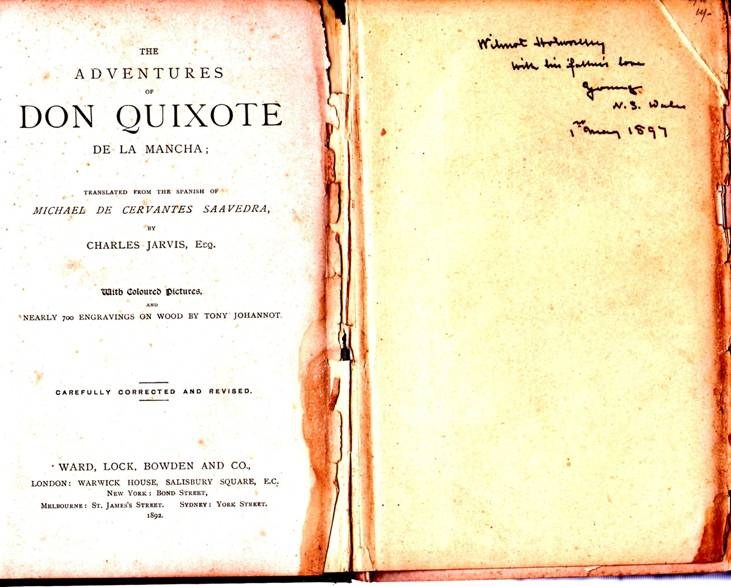
Inscriptions in books belonging to Wilmot Holworthy have placed the Holworthy name in Young as late 1897. One says “Wilmot Holworthy with his father’s love, Young N.S Wales 1st May, 1897”...this was obviously a gift for Wilmot’s 14th birthday, but he was supposedly back in Noumea by this time, so the ‘Young N.S Wales’ must have been referring to the location of his father at that time.
Wilmot was sent back to Noumea c. 1890 for his schooling, and as a result grew up with French as his preferred language. Wilmot still had family back in Noumea...his maternal aunts Minnie and Aline Hughan were still in residence there, although his grandmother Phoebe Berry Hall Hughan permanently relocated to Sydney in 1889 as her health was not the best.
While Wilmot was back in Noumea receiving his education, his father was courting a woman in view to making her his wife. In 1894, at the age of 57 years, Francis Charles Holworthy married Tasmanian-born Williamina Norwood, 33, at Kiama, NSW. Just briefly, Williamina’s family history was as follows:
Williamina Norwood born March 4, 1861, Launceston, twin daughter of William John and Eliza Norwood. Her twin brother William died infancy. Other siblings:
Francis Edward b March 31, 1851, Launceston. Married Eleanor White, 1876, Hobart. Died 1938, Burwood.
Kate Norwood born May 17, 1853, Launceston. Married Edward H. Mutton, 1879, Orange NSW.
Isabel Norwood born July 24, 1855, Launceston.
Annette Norwood born June 19, 1858, Launceston. Married Frederick Strachan, 1880, Bathurst.
Henrietta Norwood born March 18, 1863, Launceston. Spinster. Died Neutral Bay 1948, aged 86.
Arthur Norwood born May 26, 1866, Launceston. Died North Sydney, 1945.
There is a William John Norwood who died in Bathurst in 1889 aged 72, son of John Norwood- this is probably Williamina's father. Williamina’s father, William John Norwood, owned land and real estate in Tasmania, and at one stage was manager of the Union Quartz Crushing and Mining Company based in Launceston.
I don't know what happened to Williamina's sister Isabella- the following NSW Police Gazette report of 13 September 1899 stated:
" Kiama: On the 19th ult, Isabella Norwood left the residence of Mr. Frederick Strachan, City Bank, Kiama, and has not been since seen or heard of. She is described as about 35 years of age, medium height, slight build, pale complexion, brown hair, dressed in a black skirt, navy blue blouse, straw hat and slippers. Her hat and hankerchief were subsequently found on the rocks near the Blow Hole, and as her mind had been somewhat deranged of late, it is surmised that she committed suicide by throwing herself into the sea."
The West Australian paper of 22 August, 1899, reported:
"Sydney, August 21: Isabella Norwood, who was on a visit to Kiama from Orange, disappeared on Saturday afternoon. Search was made, and her handkerchief was discovered on the rocks near the Blow Hole. No other traces of the girl were seen. She had been suffering from insomnia."

Williamina's eldest brother, Francis Edward Norwood, also found himself in a bit of strife which landed him in goal for two years. He was the auditor for Anglo-Australian Bank in Melbourne and together with the three directors and manager, found himself on trial for “unlawfully concurring in making a certain written statement, well knowing it to be false, with intent to defraud the creditors of the Anglo-Australian Bank”.
This happened in 1892-1893. There is a fabulous sketch showing the five of them -including Francis Norwood- on trial on the Picture Australia site, which is replicated on the following page.

Francis Holworthy and his new wife did not give Wilmot any siblings as their marriage was childless. Letters in Wilmot’s cigar box from Williamina reveal that she loved him as her own son, signing the letters “ Your ever affectionate mother”.
It is not known how long Francis and Williamina remained in Australia after their marriage, but there are shipping records which show that in 1905 the couple set sail from Sydney to Southampton in England on the ship ‘Bremen’.
By then Wilmot was aged 22, and for a period after finishing school he worked in a Sydney bank. According to Holworthy family stories, Wilmot spoke mainly French, and actually struggled a little with the English language. He did not remain in Sydney for long, and found himself in New Zealand.
The shipping records of 1905 throw confusion over the whereabouts of Francis Holworthy and his wife Williamina. In March there is an entry for F. Holworthy and Mrs Holworthy arriving in Sydney from Auckland on the ‘Zealandia’. There is another one in late May for the ‘Warrimoo’ arriving back in Sydney from Wellington with two Holworthys on board.
Finally, there is the passenger reference already mentioned previously....on April 25, 1905, the shipping index shows the arrival in Southampton, England, of Mr F. & Mrs Holworthy from Sydney per the ‘Bremen’.
Their son Wilmot must have enjoyed life in New Zealand, because there he remained for the rest of his life. He married into a very artistic family when he wed Madeline Esther Watkins in New Zealand in 1913. She was the daughter of very well-known artist Charles Henry Kennett Watkins who, from 1879 to 1890, was principal of the Auckland Free School of Art.
Wilmot Holworthy set himself up as a sheep farmer with an advance on his expectations from England- he knew he was to receive bequests in the wills of several relatives.
His son Allan Charles Holworthy was born in New Zealand in 1915, and like his father before him he grew up as an only child.
Tragedy was the cause of Wilmot’s not remaining as a farmer...a neighbouring farmer was burning off and the fire got away, burning out Wilmot entirely. He lost everything and had to walk off his property, but- thankfully for his descendants today-he still had his Cigar Box and its precious genealogical treasures.

Two of those treasures that Wilmot kept included two of the letters written to him by his stepmother Williamina Holworthy after the death of Francis Holworthy. One is replicated as follows:

___ford Park,
Ilfracombe,
North Devon.
7th October, 1923.

My Dear Wilmot,
This is but a few lines to tell you I am leaving England for Rome on the 15th of this month, and I go to London for a day or so at the end of this week.
I wrote to you in April last to tell you I had arrived from Rome, but there has been no answer from you. I also wrote before leaving Rome- I have been in North Devon for six months, four months here in Ilfracombe and two in Woolacombe, which is a little place quite near.
Now the Winter is coming on, and I must return to Rome and shall be very glad to get there. These six months have gone by, but as you can understand, with much sadness for me, for I miss your father even more than ever. And it has been dreadfully lonely for me, if it had not been for my reading I do not know how I could have got through so long a time, but it is such a great resource! I find I have read and studied 8 plays of Shakespeare since I have been in the country.
When the weather was warm one could take a book and sit out of doors a good deal. But this last month there has been nothing but rain and wind, and sometimes such a gale blowing that I could not go out for fear of being blown down. North Devon and Ilfracombe in particular is all open to the Atlantic so the storms are sometimes very great, though it is protected by some high Tors and the coast is quite beautiful and quite rugged, rocks everywhere.
The “stone” is finished and placed over your dear Father’s grave, where he lies in the little cemetery over the hills there, which I see from my window. I went there yesterday and put in three pieces of rosemary, you know “there’s Rosemary for Remembrance”. One piece I put for you , and one for myself, and the other for my dear friends in Rome who loved him so much.
The stone is very simple, just what I wished it to be, and it is a beautiful boulder of Cornish granite and glistens like rough marble and stands four feet high and about 1 ½ feet thick, and then at the foot there is the Rosemary and nothing more. I am so thankful to have been able to do this out of my own savings and it is what I came to England for.
I will enclose you a photograph I have had done of it. It looks better than the photo. The Cemetery is on the side of a high hill called the ‘Cairn’ and it is the quietest and most peaceful spot you can imagine. Not a house to be seen from it, and below it there is a rushing brook.
I have written a longer letter than I intended when I commenced, so I will close now. I have been living quite alone here in Ilfracombe. I took a room next to Mrs Pope’s with a private family that is in Number 8 where I still ____. Number 7 is a boarding house and it was all full for the season soon after I came to Ilfracombe so that is the reason I moved.
I shall hope to hear from you soon, and that you are all well and that your prospects are looking brighter than they were when you wrote.
With my love to you all,
Your most affectionate Mother,
W.Holworthy.”

Francis Charles Holworthy had died in Devon in 1922, aged 84, and his widow’s description of his grave stone and the ‘Rosemary for Remembrance’ is very touching. Williamina Holworthy lived as a widow for another twenty years after her husband’s death. She died on September 5, 1942, and a notice in the London Gazette gave her address as “Late of the Mount Hotel, Ilfracombe’.

Death of Ruth Hughan Holworthy

Marriage certificate of Ruth Hughan and Francis Holworthy